日程安排
Embark on an unforgettable 8-day liveaboard journey through the Galapagos Islands, one of the most iconic diving destinations on Earth. From the moment you arrive in San Cristobal, you’ll be immersed in the unique beauty, wildlife, and underwater wonders that make the Galapagos truly extraordinary.
Sample Itinerary
Day 1 - Arrival
AM: This morning, you will fly from the mainland of Ecuador to San Cristobal, Galapagos. Our guides will be there to greet you and escort you to the yacht.
PM: After getting settled in, we will have lunch and briefings, followed by a check dive at Isla Lobos. Lobo is Spanish for wolf, and sea lion is lobo del mar in Spanish. Expect to see sea lions. We sail to Marchena overnight.
Day 2 - Punta Carrion and Seymour
AM: Punta Carrion is located on the island of Santa Cruz. Sometimes we get lucky and see mola molas here. It’s a good first dive to acclimatize to Galapagos diving.
PM: Seymour is an island known for having great dives. Sightings include mobulas, white tip reef sharks, Galapagos sharks, sometimes Hammerheads and many fish species.
Day 3 - Wolf
AM: Wolf is one of the reasons Galapagos is on most divers’ bucket lists. Scientists have designated Wolf and Darwin (together as they are so close together) as the sharkiest place on earth because they have the largest biomass of sharks on the planet, 17.5 tons of sharks per hectare (2.47 acres). Only divers visit Wolf. There is no chumming in Galapagos. This is where sharks come naturally. There are no land visits. Wolf is located 115 miles north of the central islands.
PM: Sightings include huge schools of Hammerhead sharks, Galapagos sharks, Whale sharks (in season), Silky sharks, Eagle Rays, Sea Lions, Fur Seals, Mantas, Turtles, Jacks, Trumpetfish, Butterfly fish, Morish Idols, Moray Eels, and Dolphins. Some sites at Wolf are covered in coral, and all of the tropical fish species that live on coral reefs. Dive sites include Shark Bay, The Landslide, La Banan, and Islote La Ventana. On the island itself, there are hundreds of thousands of seabirds, including all 3 types of boobies in Galapagos – Red-footed, and Nazca. There are frigates, pelicans, lava gulls, and red-billed tropicbirds.
Diving begins early to get in all 4 dives in a 12-hour day. 4 dives and a night dive (optional), where you can see garden eels and the red-lipped batfish on a sandy bottom.
Day 4 - Darwin
Darwin’s Arch is an icon, the symbol of diving in the Galapagos. It is located 229 km / 142 miles north of the central islands. In addition to Wolf, this is where we find massive schools of Hammerheads. Huge, pregnant Whale sharks pass through Darwin each year for reasons unknown.
Darwin is the warmest dive site in Galapagos due to the tropical Panama current. You spend a lot of the dive stationary, on a platform that drops into the blue where Hammerheads swim against the current. It’s like being on the side of a Hammerhead highway watching traffic pass. You leave the platform to swim out into the blue when a Whale shark is spotted. That sometimes means swimming through the Hammerheads, a truly magnificent experience you will carry with you forever.
Day 5 - Darwin - Wolf
AM: We have 2 more dives at Darwin in the morning.
PM: We have 1-2 more dives at Wolf in the afternoon. There is an optional night dive at the Anchorage site. Anchorage has a sandy bottom where you may see garden eels and the red-lipped batfish.
Day 6 - Isabela - Fernandina
There are 2 different itineraries for the western sites due to seasonal visibility…or rather lack of visibility.
- JAN-MAY: Cabo Marshall (Isabela Island)
- JUNE-DEC: AM: Cabo Douglas (Fernandina Island) PM: Punta Vicente Roca (Isabela Island)
Cabo Marshall (Jan-June) is located on the eastern side of Isabela Island. Giant mantas, large schools of barracudas, Galapagos sharks, Sea Lions, Flightless Cormorants, and enormous schools of Black Striped Salemas in Galapagos. These tiny fish can be so numerous that a diver inside the school cannot be seen, only the bubbles rising above the school. 4 dives at 2 Cabo Marshall dive sites.
Cabo Douglas (July – Dec). The westernmost island in Galapagos, Fernandina, is an active volcano. It has erupted twice in the last decade. It is the ‘hot spot’ in Galapagos.
AM: This is the only site on liveaboard itineraries where you can see diving Marine Iguanas feeding underwater. You also see Penguins feeding on tiny silver Sardines using schools of Black Striped Salemas as cover. Turtles are especially abundant at Cabo Douglas, which is probably why this is a likely location to site Orcas.
Punta Vicente Roca (July – Dec). If you look at a map, Isabela Island looks uncannily similar to a seahorse. Punta Vicente Roca is located on the northwestern side of Isabela, just below the ‘mouth’ of the seahorse. Isabela has 5 active volcanoes.
PM: Punta Vicente Roca is a Mola Mola (Sunfish) cleaning station, has large turtle populations, the endemic Galapagos Bullhead shark, Penguins, Sea Horses, Sea Lions, and many species of fish not found elsewhere in Galapagos. It is not uncommon to find yourself diving with an endemic Flightless Cormorant.
Day 7 - Cousins - Santa Cruz
AM: Cousins Rock. Cousins is a small rock, the remains of an eroded crater sticking up out of the sea. On the eastern side, the rock cascades down in a series of recessed ledges strewn with black coral, which is bright green under the water. Taking cover in the coral, you may find Seahorses, Frogfish, Octopus, Turtles, and the elusive Longnose Hawkfish. It’s not unusual to spot pelagics from Cousin's, including Mantas, Eagle rays, Mobulas, and Hammerheads. Sea lions and fur seals are also at Cousins. 1-2 dives depending on the mood of the divers.
PM: We disembark and head for a reserve in the Santa Cruz Highlands to see the iconic Galapagos Tortoise in its natural habitat.
After the Highlands, we descend into the largest town in Galapagos, Puerto Ayora. You may opt to visit the Charles Darwin Research Center in the Galapagos National Park or wander about town.
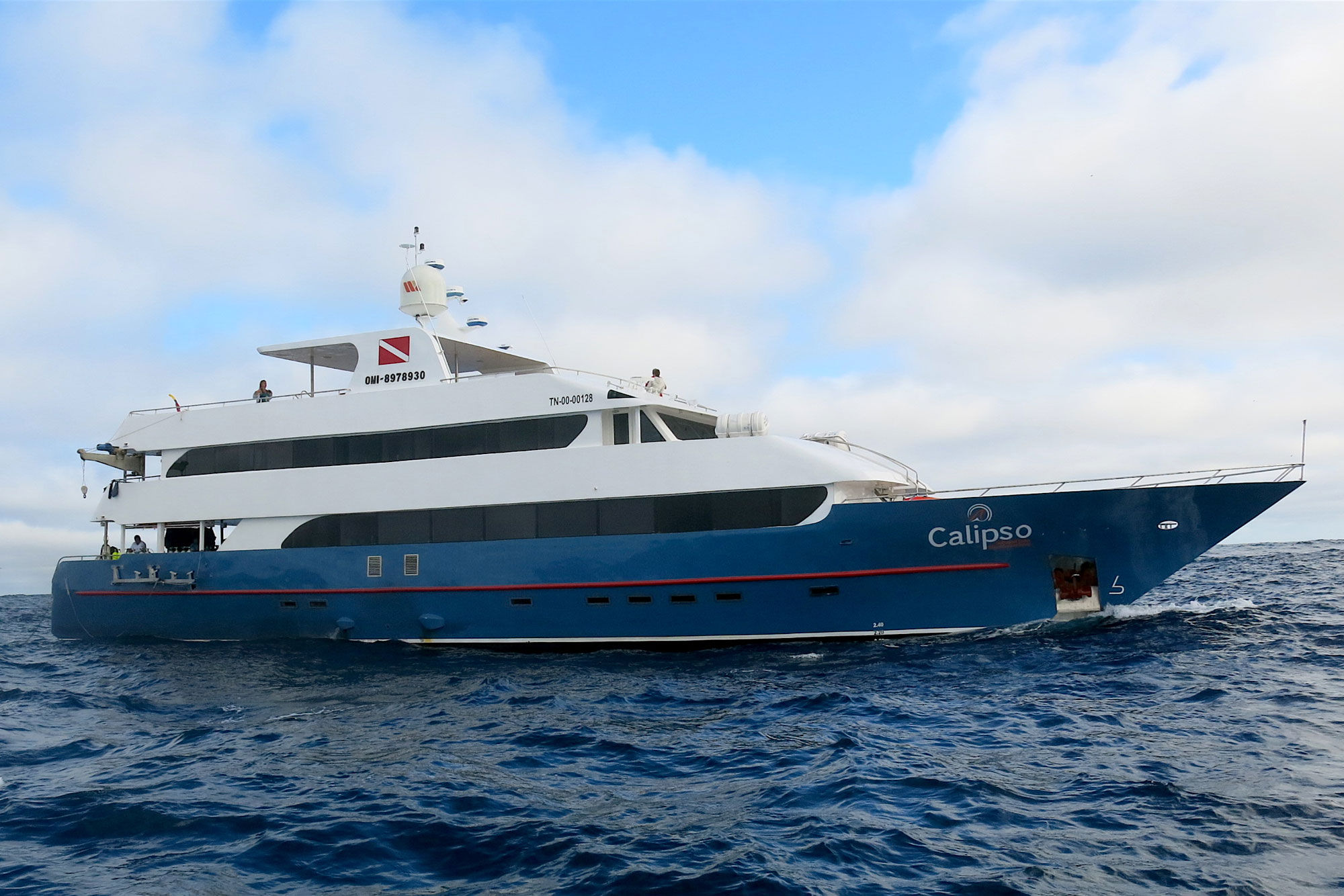
Our farewell dinner will be at a restaurant in Puerto Ayora. We then return to Calipso and sail to San Cristobal overnight.
Day 8 - Departure
AM: You will disembark and are free to visit the Interpretation Center or wander around the port before going to the airport for your departure.
On this trip, you’ll encounter an incredible diversity of marine life, including hammerhead sharks, Galapagos sharks, whale sharks, and silky sharks in their natural habitat. Swim alongside sea lions, dolphins, mantas, and turtles, and spot unique species such as marine iguanas, flightless cormorants, penguins, and endemic Galapagos fish. Thriving coral reefs, vibrant schools of tropical fish, and seasonal visits from mola molas (sunfish) complete an unforgettable underwater experience.
The last dive will be on the penultimate day of the trip. Divers are recommended to wait for 24 hours before flying after the last dive.
(*) The itinerary description is provided by the boat operator. Sample itineraries and maps are for illustrative purposes only, and the exact route and sites visited may change based on local regulations, guest experience, weather, and logistics, at the Captain’s discretion.